Fast service starts with the right kiosk layout
A stadium kiosk is not a full restaurant kitchen squeezed into a smaller room. It is a service point built for a match day rush, with a narrow menu, prepped stock and clear movement from cold storage to final handover. In Durban, where humidity and salt air can punish equipment, the layout must also make cleaning, ventilation and maintenance simple.
We usually start with the queue side, service hatch and pass counter, then work backwards. The operator needs enough counter space for assembly, ticketing and drinks, but not so much that staff are forced to walk around each other. For most kiosks, a straight line or L-shaped layout works best, especially where the footprint is under 20 m2. If your stadium has municipal compliance checks, fire access and extractor discharge points also need to be built into the drawing early.
- Keep hot items close to the pass for short handover time
- Separate prep, cooking and wash-up where possible
- Allow one clear staff route and one customer service route
- Leave access for cleaning, gas checks and electrical isolators
Equipment that suits short-rush concession service
Most stadium kiosks do not need large cook lines. They need dependable equipment that comes up to temperature quickly and holds service through a busy spell. The exact mix depends on the menu, whether you are serving chips, burgers, toasted items, chicken, pies or cold drinks, and whether the kiosk has single-phase or three-phase supply. Load-shedding backup also matters if the venue does not have stable changeover power.
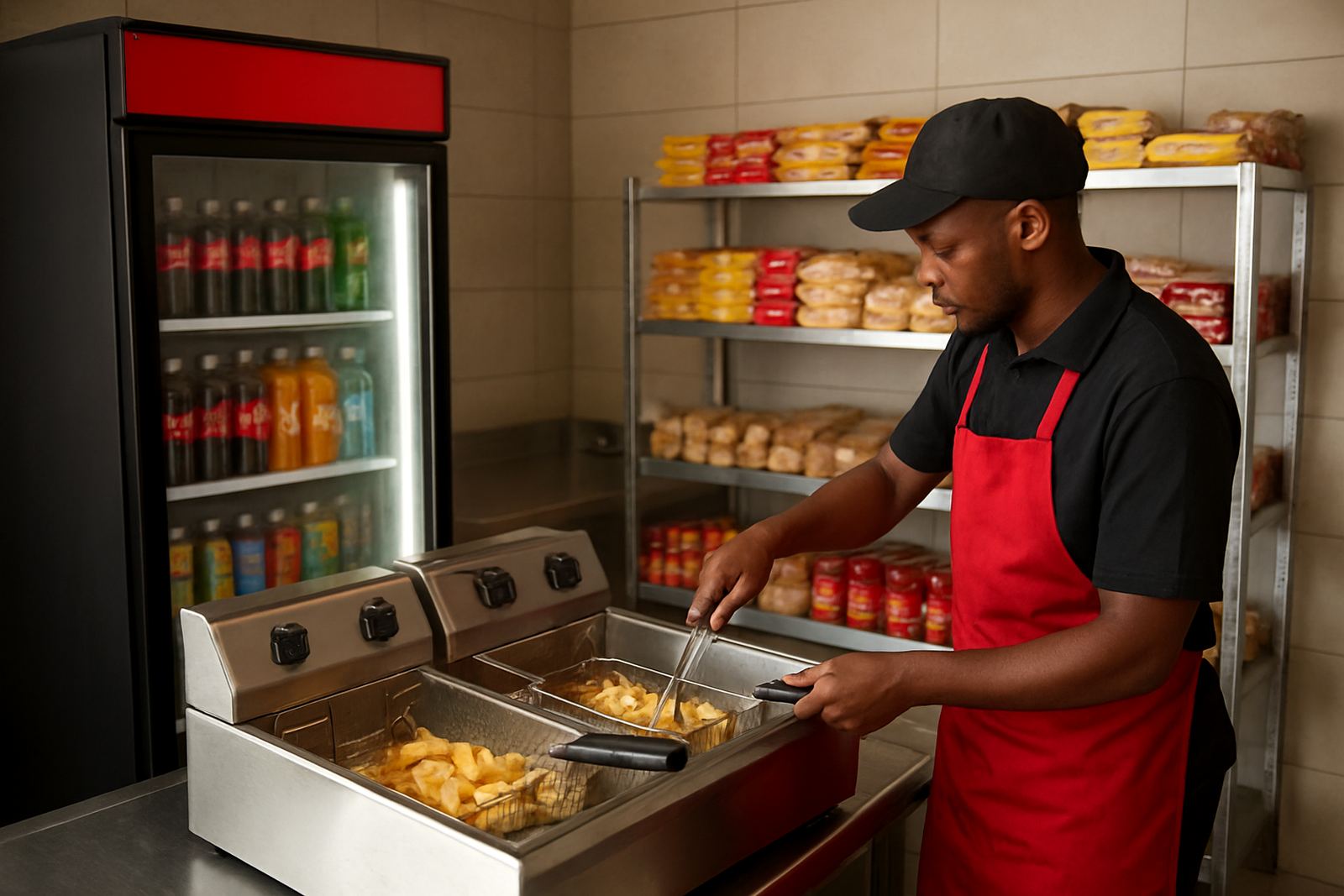
Common equipment includes undercounter refrigeration, upright fridges or freezers, a grill or griddle, fryer, hot holding unit, stainless prep tables, handwash basin, dry ingredient shelving and a pass counter. If drinks are part of the offer, a compact bottle fridge or can fridge saves space and keeps stock visible. In coastal areas, we also recommend stainless where it sees daily use, because cheaper finishes can corrode faster than expected.
- Undercounter fridge or freezer for stock under the worktop
- Small griddle or contact grill for fast menu items
- Double fryer where fried items are a major seller
- Hot holding cabinet or heated top for peak periods
- Handwash sink and splashback for hygiene control
Planning for queues, power cuts and cleaning windows
Stadium work is all about timing. The kiosk may be quiet for most of the week, then full for 20 minutes before kick-off and again at half-time. That means the layout should reduce steps, reduce bottlenecks and make the most used items sit within arm’s reach. We also plan for the realities of South African supply conditions, including load-shedding and occasional water interruptions. A kiosk that cannot recover quickly after a power event becomes a problem very fast.
Good planning covers more than the equipment list. It includes extractor sizing, make-up air, grease trap access, drainage fall, non-slip flooring and service doors for maintenance. Where staff numbers are small, a pass-through window and a single prep lane usually works better than a wide open room. If the space will be cleaned by contract teams after events, the floor and wall finishes need to handle frequent washdowns without trapping dirt in joints.
- Position the fryer and grill under proper extraction
- Plan for quick restart after power interruptions
- Use easy-wipe finishes around the pass and prep area
- Keep consumables close to the packing point
- Allow space for refuse bins and used oil handling
Common kiosk mistakes that slow service
The biggest mistake is overloading the menu. A kiosk with too many products takes longer to train, longer to stock and longer to serve. Another mistake is choosing equipment by size only, then finding the service lane is too tight or the fridge doors block the walkway. We also see sites where the counter depth is correct on paper, but there is no room for trays, packaging and payment devices.
Another issue is forgetting the back-of-house basics. A kiosk can look ready from the customer side and still fail because the extractor outlet is wrong, the electrical point is too far away, or the handwash basin was left out. In some stadiums, no one allows for a wet waste point or a secure store for packaging, so staff end up carrying stock in and out all day. It is messy and slows everything down.
- Too many menu items for a small team
- Oversized equipment that blocks movement
- Poor extractor planning above frying or grilling
- No place for packaging, napkins or sauces
- Unclear cleaning access behind equipment
Budget ranges for stadium kiosks in Rand
Budgets depend on the size of the kiosk, the menu, the amount of fabrication needed and whether refrigeration, cooking and extraction are all being supplied as a package. A very basic cold-drinks and snack kiosk can start from about R120 000 to R250 000. A compact hot-food kiosk with prep, cooking, extraction and refrigeration often sits in the R280 000 to R650 000 range. Larger or higher-volume stadium concessions with custom stainless counters, multiple cooking points and stronger utility upgrades can move beyond R750 000.
These figures usually change once site surveys are done. Power upgrades, gas storage, drainage, fire compliance and stainless fabrication can shift the final number quite a bit. It is better to price the kiosk around the actual menu and service rate than to buy equipment first and force the layout later. That is where many projects run over budget.
How we handle stadium kiosk projects in Durban
We work from Glen Anil in Durban and cover Durban North, Umhlanga, Pinetown, Ballito and Pietermaritzburg. For stadium kiosks, our process starts with a site survey and equipment specification, then we move into kitchen layouts, extractor planning and stainless fabrication where needed. Once the plan is signed off, we handle installation, commissioning and staff training so the team knows where every item sits and how the service flow is meant to work.
Our projects team also checks the practical side, such as service access, clearances, power points and maintenance routes. That matters because kiosk equipment gets hard use on event days and needs proper upkeep between matches. If something fails during a rush, our breakdown repairs and preventative maintenance support can keep the kiosk trading with less downtime.
- Kitchen layouts sized to the actual kiosk footprint
- Equipment specification matched to menu and power supply
- Stainless fabrication for counters, sinks and splash areas
- Installation and commissioning by an experienced site team
- Training for daily use, cleaning and shutdown routines