
What a vegetable prep machine does in a busy kitchen
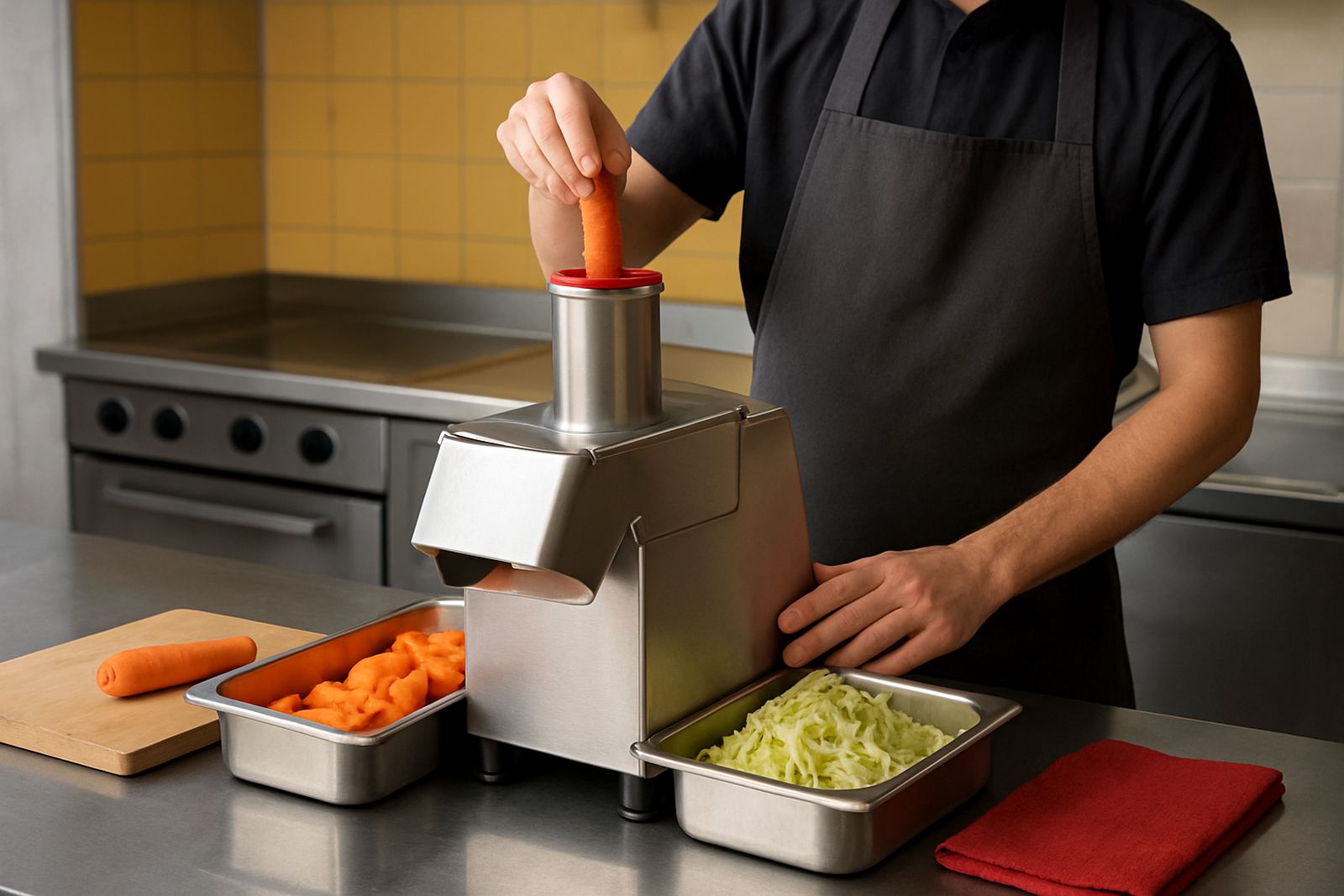
A vegetable prep machine is a bench or floor standing food-prep unit fitted with interchangeable discs or cutting sets. It takes washed vegetables and turns them into uniform slices, chips, dice, shreds or gratings in a short time, which helps with portion control and reduces strain on staff doing repetitive prep by hand.
In Durban kitchens this equipment is often used for cabbage, onions, carrots, beetroot, lettuce, cucumber, peppers and similar produce. For schools, hospitals and contract caterers, the main benefit is consistency. When every tray is cut the same way, cooking times are more even and food presentation stays better across a full service.
If your site does large lunch runs, packed meal production, or early morning prep before service starts, this machine can take pressure off the line. It also helps when load-shedding affects your service window because prep can be done ahead of time and held correctly in cold storage.
Sizes, drive types and cutting options
Vegetable prep machines come in different sizes depending on output and counter space. Smaller units suit cafés and smaller restaurants with lighter daily use, while larger commercial models suit canteens, hospitals and central kitchens that process many kilograms a day.
Most machines are electric and use a single-phase or three-phase motor depending on capacity. Smaller models often run on 220 V single-phase power, while high-output machines may need 380 V three-phase supply. The right choice depends on your daily volume, the type of vegetables you cut most often, and how many operators will use the unit.
- Bench-top models for compact prep areas
- Heavy duty models for continuous service
- Single-phase or three-phase options, depending on load
- Interchangeable discs for slicing, dicing, grating and julienne cuts
- Feed hoppers and chute sizes to suit different produce
Some kitchens prefer a larger feed opening for whole cabbage or bulky carrots, while others need a finer feed system for controlled portioning. We match the machine to the menu and the pace of the site rather than pushing one size for every kitchen.
Where it suits best in Durban and KZN kitchens
This equipment suits any operation that processes vegetables daily in volume. We supply and fit vegetable prep machines into restaurants in Durban North and Umhlanga, production kitchens in Glen Anil and Pinetown, and higher volume sites in Ballito and Pietermaritzburg. It is also common in hospital kitchens, school canteens, retirement facilities and factory feeding schemes.
Coastal kitchens need equipment that can cope with humidity and frequent wash-downs. Stainless steel contact parts are important, and the machine must be positioned where it is easy to clean around and where airflow is good. In tight prep rooms we often plan a stainless table, drainage access and enough space for safe feeding and collection of cut product.
- Restaurants and bistros with lunch and dinner prep
- Hospitals and care facilities with controlled portioning
- Canteens and contract caterers serving large headcounts
- Meal production kitchens and commissaries
Installation, power and site requirements
Correct installation makes a real difference to safety and performance. The machine needs a stable level surface, enough clearance for loading and unloading, and power sized to suit the motor rating. If the site has a standby generator, inverter or changeover arrangement for load-shedding, we check the start-up current and whether the circuit can carry the machine without nuisance tripping.
For three-phase units, we confirm that the supply is correct before commissioning. For single-phase units, the socket position and cable run must be practical and protected from water. Where prep areas are part of a larger kitchen build, we can plan the machine location alongside sinks, chillers, work tables and waste points so the flow works properly.
We also consider cleaning access. The area around the machine should allow staff to remove discs, wipe down the hopper and keep floors dry. If a site has strict municipal or health inspection requirements, it is worth making sure the layout supports quick cleaning and safe movement of staff during peak prep times.
Care, cleaning and servicing to keep it cutting cleanly
A vegetable prep machine lasts better when it is cleaned after every use and serviced at set intervals. Food residue can build up around blades, discs and drive parts if staff rush the wash-down. That leads to poor cutting quality, extra wear and, in some cases, contamination risk. The machine should be isolated before cleaning and the cutting set handled carefully.
Routine care should include inspection of the blades, checking guards and seals, and making sure the motor area stays dry. In humid coastal conditions, it is wise to keep the machine covered when not in use and to avoid storing wet parts in the unit. If the kitchen uses the machine all day, preventive maintenance is better than waiting for a breakdown during service.
- Wash and dry discs properly after each shift
- Check blades for dullness or damage
- Look for loose fasteners and worn seals
- Keep the motor vents clear of dust and grease
- Book planned servicing before peak seasons
Our service team handles preventive maintenance and breakdown repairs in Durban and surrounding areas, which helps keep prep moving when orders are full and there is no time for slowdowns.
What to check before you place an order
The right machine depends on your menu, staff numbers and daily volume. Before ordering, it helps to know what vegetables are cut most often, what finishes you need, and whether the machine must work from the existing electrical supply or a planned upgrade. A site that only needs slicing for salads is very different from a hospital kitchen doing mixed prep all day.
We usually ask clients to confirm a few practical points so the machine arrives suited to the job. That avoids paying for features that will never be used, or under-sizing a unit that will struggle under pressure.
- Daily quantity of vegetables to be processed
- Cut types needed: slice, dice, grate, shred or julienne
- Available power supply, single-phase or three-phase
- Bench space and clearance for feeding and discharge
- Whether the site needs stainless stands, tables or collection bins
- Cleaning routine and staff training needs
If you are planning a new kitchen or replacing an old prep unit, we can also advise on the best position in the room so the machine sits close to storage, washing and cold holding areas. That keeps the prep line moving and cuts down on wasted steps.
KZN Catering Equipment support for supply and setup
KZN Catering Equipment has been working from Glen Anil, Durban since 2007 and supplies commercial kitchen equipment across KwaZulu-Natal. Our team can assist with kitchen layouts, equipment specification, extractor planning, stainless fabrication, installation, commissioning, training and ongoing servicing. For vegetable prep machines, that means you get advice on the full prep area, not only the unit itself.
If you are fitting out a restaurant, hospital or canteen, we can help you choose a machine that suits the menu and the daily workload. We also support after-sales needs such as spare parts planning, maintenance schedules and site visits when the machine needs attention.
For product enquiries, use our contact form or speak to our Durban team about supply into Glen Anil, Durban North, Umhlanga, Pinetown, Ballito and Pietermaritzburg.
Key facts
| Product type | Commercial vegetable prep machine for slicing, dicing and grating |
|---|---|
| Typical power | 220 V single-phase or 380 V three-phase, depending on model |
| Output use | High daily volume food preparation |
| Cutting options | Slices, dice, grates, shreds and julienne cuts |
| Construction | Stainless steel food contact parts with heavy duty motor housing |
| Best suited to | Restaurants, hospitals, canteens, schools and production kitchens |