
Start with the wash-up volume, not the room size
Before you choose sinks or a dishwashing machine, work out how many items come back from service at your busiest time. A restaurant serving 120 covers has a very different wash-up load to a hospital kitchen washing trays, GN pans and bulk utensils all day. Count plates per service, pot sizes, cutlery baskets, and whether you need to handle cups, baking trays or insulated containers.
In Durban and along the North Coast, many kitchens also need space for double duty. The same area may handle breakfast wash-up, lunch trays and prep equipment from the afternoon shift. If the room is too small, dirty items pile up and clean items have nowhere to drain. That is when staff start stacking wet crockery on trolleys and the whole area slows down.
- Count peak hour items, not only daily totals.
- Allow for storage of dirty, washed and air-drying items.
- Check if the wash-up area also needs pot wash or vegetable prep overflow.
- Leave a clear path from service, bussing point and stores.
Set out the sink line for cleaner movement
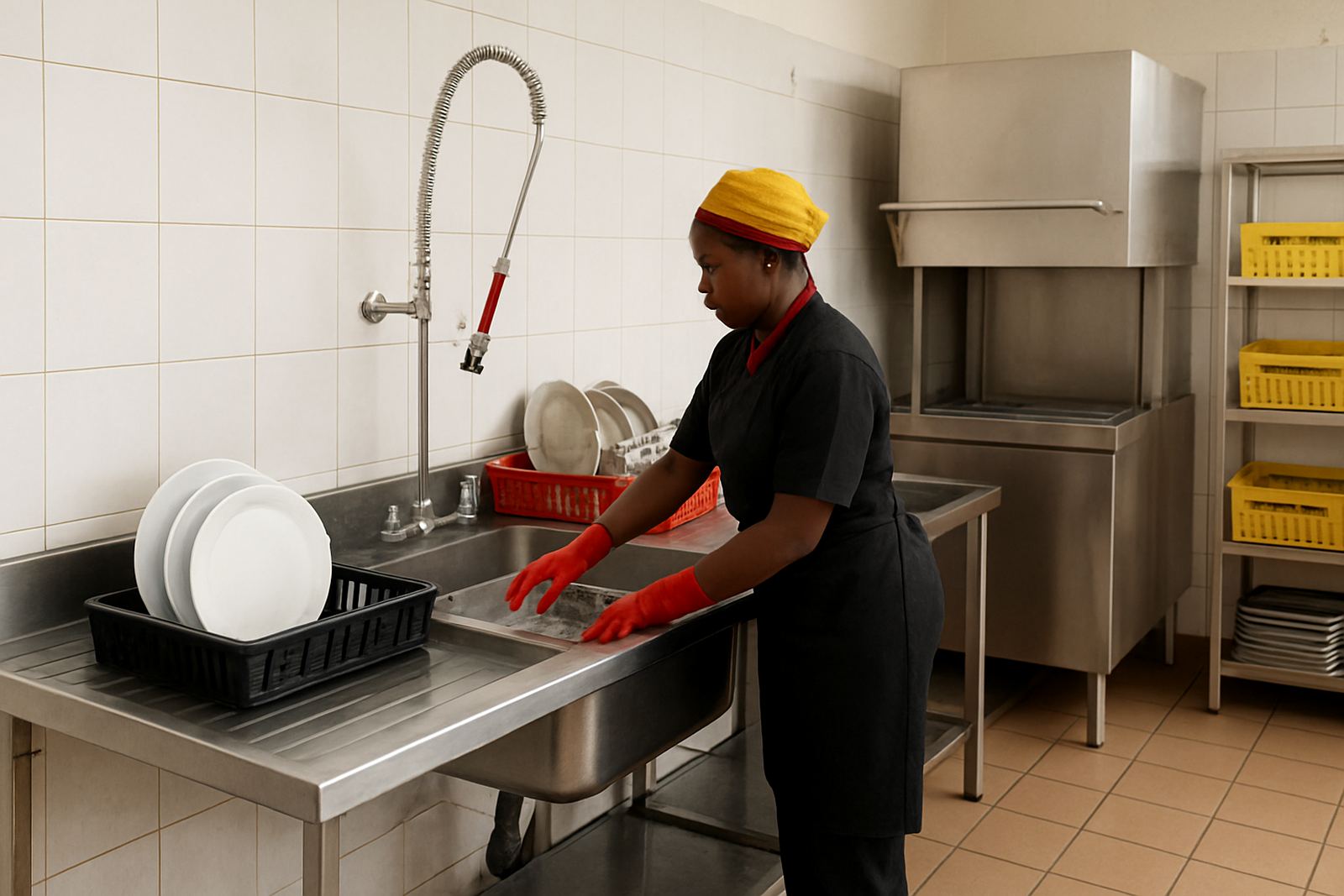
A proper sink line should separate scraping, washing, rinsing and drying. Most commercial kitchens need a pre-rinse or scrap table, a wash sink, a rinse sink and a drain area. In some sites one deep bowl sink is enough for light use, but busy operations need more than one station so staff are not standing on top of each other.
Place the dirty drop point closest to the entrance from the dining area or servery. Put clean storage and rack return at the other end. This simple flow reduces cross traffic and makes training easier for new staff. Stainless steel is usually the best choice because it handles steam, splashes and daily cleaning better than mixed materials. In coastal towns like Umhlanga, Ballito and Durban North, good-grade stainless also helps with humidity and salt air.
- Keep the dirty side and clean side separated.
- Use wall-mounted or leg-supported stainless tables where floors need easier cleaning.
- Fit adequate drainboards so items can dry without crowding.
- Check that taps, mixers and spray points can reach every bowl safely.
Choose the right machine for the kitchen type
Not every site needs the same dishwashing machine. A small café may manage with a compact undercounter unit, while a canteen, hospital or school kitchen often needs a hood-type or conveyor-style machine for higher volumes. The right choice depends on basket size, cycle time, water recovery, electrical supply and how many staff are assigned to the area.
Also consider your utility conditions. Some sites in KwaZulu-Natal have load shedding, water pressure changes or limited hot water capacity. If the machine cannot recover quickly, the wash-up area becomes a bottleneck during service. We often plan around backup hot water, surge protection and clear access for maintenance so the machine can keep working when conditions are not ideal.
- Match machine capacity to peak service, not only average use.
- Check water temperature requirements and recovery time.
- Allow space for infeed, outfeed and drying racks.
- Make sure the machine can be serviced without moving the whole line.
Plan racks, trolleys and drying space properly
Racks are often treated as an afterthought, but they can make or break wash-up flow. If racks are the wrong size, staff waste time repacking items and clean crockery gets damaged. Plan enough rack space for plates, cups, cutlery, pots and trays, and make sure trolleys can turn easily through doors and corners. In older buildings around Pinetown or Pietermaritzburg, narrow passages and uneven floors often need extra care.
Drying space should be close to the machine or rinse sink, but not in the splash zone. Items need to drain without being touched too soon. If your kitchen uses speed racks, nesting trays or bakery pans, check that shelf spacing suits the exact item sizes you use. A few millimetres too tight can turn into daily frustration.
- Measure rack widths, trolley height and doorway clearances.
- Provide enough air-drying space for peak turnover.
- Keep clean storage away from traffic and splashes.
- Label racks clearly so items return to the right area.
Use surfaces, drainage and finishes that suit real cleaning
Wash-up areas take more abuse than most parts of the kitchen. Hot water, detergents, food scraps and constant movement all wear on the finishes. Floors should drain correctly so water does not collect around feet, walls or machine bases. Poor drainage leads to slipping, smells and more time spent mopping during service. In some municipal inspections, standing water and hard-to-clean corners become a problem very quickly.
Choose coved skirting where possible, and avoid ledges that catch grime. Stainless splash backs, sealed joints and easy-access floor traps make daily cleaning faster. If the room is near an exterior wall, check for moisture ingress and condensation, especially in summer humidity. Small details like tap positioning, hose storage and waste bin placement affect how tidy the area stays, and how fast the team can reset after a rush.
Commission, train and maintain before the first busy service
Once the equipment is installed, test the whole wash-up line under real conditions. Run dirty items through the system, check splash points, confirm the racks move cleanly and make sure the machine cycles match staff pace. It is better to find a problem during commissioning than on a Friday lunch rush.
Staff training matters just as much as equipment. Show the team where to scrape, where to sort, which chemicals to use, and how to shut down the machine safely. Keep a simple cleaning and maintenance log near the area. A well-run wash-up section saves water, reduces breakages and helps the kitchen stay organised when volume climbs.
- Test with real pots, pans and trays before handover.
- Train staff on pre-rinse, loading and safe unloading.
- Record daily cleaning and weekly checks.
- Arrange preventive maintenance to avoid breakdowns during peak trading.